

In the industrial field, there is a type of pump specifically designed to handle liquids that are dirty, thick, and contain sand and rock particles. This pump is called a slurry pump. You may have seen it in a coal washing plant in a coal mine, or heard its roar in the ash removal system of a power plant, or seen it gulping mud in a river dredging site. The biggest difference between a slurry pump and a water pump lies in that the water pump pumps clean water or liquids close to clean water, while the slurry pump is inherently designed to handle slurry containing solid particles. These solid particles could be coal ash, mineral powder, sand, or even crushed stones. Ordinary centrifugal pumps would wear out and break down quickly when encountering these substances, but the slurry pump can operate stably for a long time. So, what are the special features of the slurry pump? What issues should we pay attention to when purchasing and using it?
First of all, we need to understand the working principle of the slurry pump. It is essentially still a centrifugal pump. The motor drives the impeller to rotate at high speed, generating centrifugal force, and sending the slurry from the suction end to the discharge end. However, to deal with the solid particles in the slurry, the slurry pump has made many strengthening designs in its structure. The most obvious one is its flow components - that is, the parts directly in contact with the slurry, such as the impeller, guard plate, and volute, are all cast from high-chromium alloys or other wear-resistant materials. This material has extremely high hardness and can resist the erosion and impact of the particles, with a service life several times longer than ordinary cast iron parts. Additionally, the impeller design of the slurry pump is different from that of the water pump. Its blades are thicker and the channels are wider, aiming to prevent blockage by particles and reduce wear. Some large-scale slurry pumps also adopt a double-shell structure, that is, there is a replaceable wear-resistant lining inside and an external pressure-resistant shell outside, so even if the lining is worn out, only the lining needs to be replaced instead of the entire pump, greatly reducing maintenance costs.
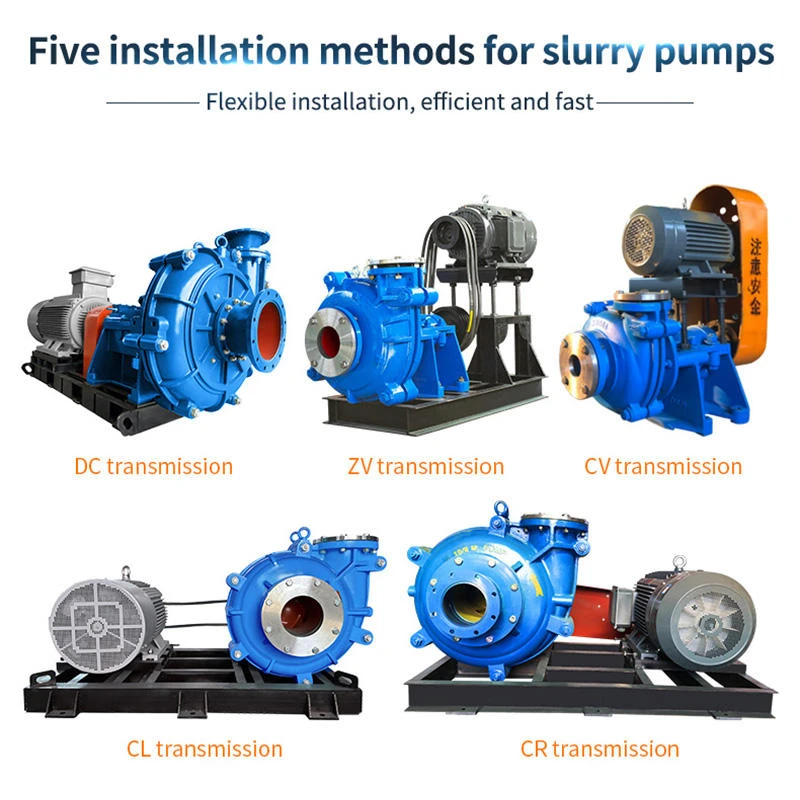

So, in the actual selection process, which parameters do we need to pay the most attention to? The first one is flow rate and head, which is the same as that of ordinary pumps. You need to know how many cubic meters of slurry need to be transported per hour, and how high the slurry needs to be lifted or how much pipeline resistance needs to be overcome. But there is another very important parameter for slurry pumps - the maximum particle size that can pass through. If your slurry contains coarse particles with a diameter of more than 10 millimeters, you must choose a slurry pump model with a wide enough channel; otherwise, the particles will get stuck in the impeller, causing blockage or even damaging the impeller. The second parameter is concentration, which is the percentage by weight of solid substances in the slurry. The higher the concentration, the thicker the slurry, and the greater the power required, and the more severe the wear. Generally, slurry pumps can handle a wide range of concentrations, from a few percent of low concentration to 60-70 percent of high concentration. However, different concentration conditions require different impeller designs and rotational speeds. The third parameter is the corrosiveness of the medium. If the slurry is acidic or alkaline, the material of the flow components cannot only use wear-resistant high-chromium alloys, but also need to consider corrosion-resistant stainless steel or rubber linings. The fourth parameter is the installation method. Slurry pumps have two types: horizontal and vertical. Horizontal pumps are the most common and suitable for most occasions; vertical pumps can be directly inserted into the slurry pool, eliminating the trouble of filling and drawing water, and are often used for tailings transportation or sewage pool discharge.
Finally, I would like to remind everyone that the purchase of slurry pumps should not be based solely on price. A cheap slurry pump may have cut corners in terms of material quality, using ordinary cast iron instead of high-chromium alloy, or the thickness of the impeller may have decreased. Such a pump will wear out within a few months and the total cost will actually be higher. It is recommended to choose a reputable brand and clearly request to provide material reports and hardness test data for the flow-through components when purchasing. At the same time, it is best to have a set of commonly used wear parts on hand, such as impellers, guard plates, and shaft seal components, in case of emergency. After all, in industrial production, the loss caused by a one-day shutdown is often much higher than the cost of a set of spare parts.


