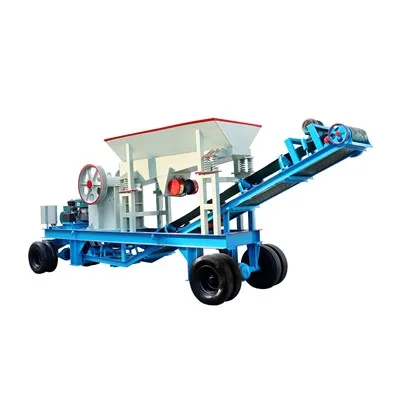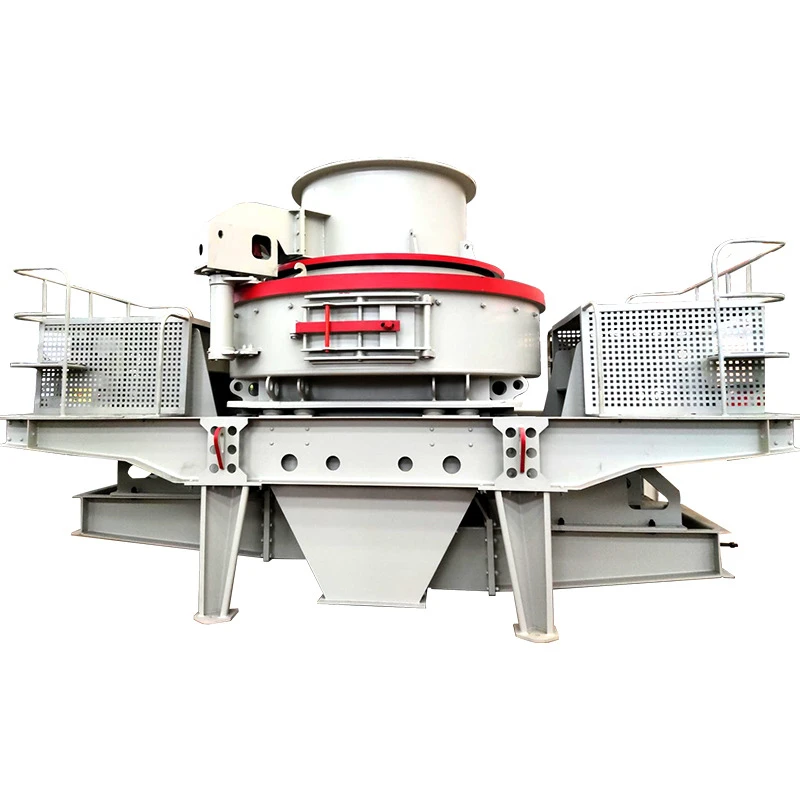
Impact sand making machine, also known as vertical shaft impact crusher, is commonly abbreviated as VSI sand making machine or impact crusher in the industry. It is the core equipment in the fields of artificial sand making and aggregate shaping. Based on the high-speed impact crushing principle combining "stone against stone" and "stone against iron", this mechanism further crushes the materials that have undergone coarse crushing and medium crushing to particles smaller than 5 millimeters into construction sand. At the same time, it optimizes the particle shape of the coarse aggregate (shaping), producing high-quality construction sand and crushed stones with reasonable gradation, round particle shapes, and extremely low needle-like and flake-like content.
The materials it is most suitable for processing include: limestone, dolomite, granite, basalt, diabase, river pebbles, quartzite, iron ore, non-ferrous metal ores, tailings, waste rocks, glass, ceramics, and almost all other materials with certain hardness. Whether it is hard rock or medium-hard rock, as long as it undergoes appropriate pre-treatment (controlling the feed particle size), the impact sand-making machine can efficiently produce qualified construction sand.
Products features
Multiple advantages ensure production safety
Multiple technological breakthroughs
Flexible feeding methods
Two modes: "falling feed + central feed" and "full central feed"
Separation of the body under large throughput
Preventing material blockage
Large discharge port design, smooth material discharge, effectively preventing
Four-stage impeller design
Large size, high product yield
Improves the crushing efficiency of the equipment and material throughput
Access door
Wear-prone parts of the impeller can be quickly replaced, reducing downtime
Products real photo


Working principle
The working principle of the impact sand crusher is based on high-speed projection and free impact, which is similar to the hammering of the plate hammers in the impact crusher. However, the design of the crushing chamber and the way of energy utilization are completely different.
The material falls from the feed opening at the top of the sand crusher and is evenly divided into two streams by the distributor (dividing disc): one flows into the center of the high-speed rotating rotor, and the other flows into the falling material channel surrounding the rotor. The material entering the rotor is accelerated by the flow channels inside the rotor, and under the action of centrifugal force, it is ejected from the ejection port of the rotor at a very high linear speed (usually 50 to 80 meters per second), forming a high-speed material beam.
The ejected material particles first collide with the stone anvil (iron anvil) fixed on the wall of the crushing chamber, resulting in "stone hitting iron" crushing; at the same time, the high-speed beam also undergoes intense collision with the falling material flow from the top, resulting in "stone hitting stone" crushing. Under the combined action of these two mechanisms, the material particles break along the cleavage plane, their edges are ground down, and the particle shape is fully optimized during the high-speed impact.
The crushed material falls to the screening area below the rotor or is directly discharged. By adjusting the rotor speed, material flow, and the air circulation within the crushing chamber (some models are equipped with a wind separation system), the fineness modulus and stone powder content of the finished sand can be controlled.
The working mode of the impact sand crusher mainly has two types:
Open circuit mode: The material passes through the crushing chamber once and is directly discharged, suitable for situations where the fineness modulus requirements are not strict or there is an independent screening and classification in the subsequent process.
Closed circuit mode: The material is crushed and enters the vibrating screen for classification. The coarse particles larger than 5 millimeters are sent back to the sand crusher via the return belt for re-crushing to form a cycle, until all reach the finished particle size requirements. The closed circuit mode is the most common configuration in manual sand production lines and can stably produce controlled fineness modulus artificial sand.
Application fields
Concrete mixing station's sand-making support: Impact sand-making machines are the most commonly used sand-making equipment in commercial concrete mixing stations. They produce mechanically made sand to replace river sand, reducing raw material costs while ensuring the strength and workability of concrete.
Dry-mixed mortar production line: There are strict requirements for the gradation and stone powder content of mechanically made sand. The impact sand-making machine, combined with a wind separation system, can stably produce fine sand that meets mortar standards.
Hydropower stations and dam projects: A large amount of high-quality artificial sand is needed, and the requirements for the grain shape and gradation of sand are extremely high. The impact sand-making machine is the preferred equipment.
Highway, railway, and bridge projects: The pavement base and concrete components are sensitive to the grain shape of the aggregate. The impact sand-making machine also has a shaping function, which can improve the grain shape of coarse aggregates and enhance the quality of the project.
Utilization of mine tailings and waste rocks: Processing the tailings or waste rocks selected from the beneficiation process into mechanically made sand to achieve resource utilization. The impact sand-making machine has good adaptability to hard tailings.
Processing of industrial raw materials such as glass and ceramics: High purity of materials is required. The impact sand-making machine can control over-crushing by adjusting parameters and reduce impurities from being mixed in.
Hot Tags: impact sand crusher, China impact sand crusher manufacturers, suppliers, factory