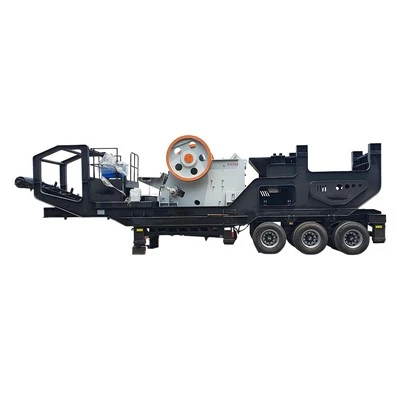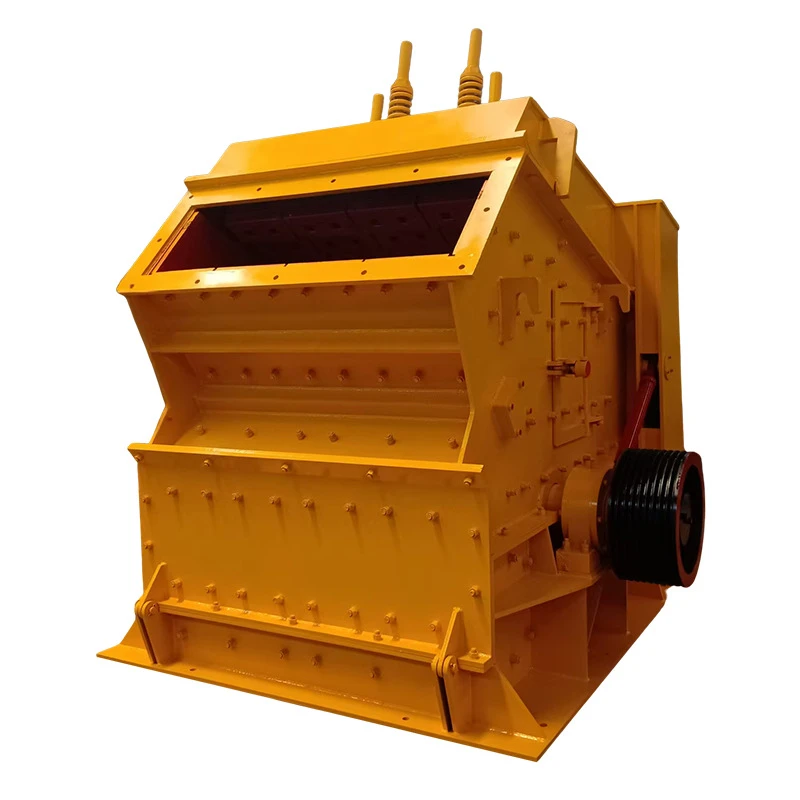
Crushing machine, also known as impact crusher, is commonly abbreviated as "impact crusher" in the industry. It is a core member of the impact crushing equipment family. Main raw materials: limestone, dolomite, gypsum, coal gangue, weathered sandstone, brick and tile fragments, concrete recycled materials, etc. These materials have a compressive strength not exceeding 150 megapascals and a low abrasion index.
Product advantages
High-quality materials The thickened steel plates and channel steel are all made from carefully selected raw materials, ensuring excellent quality.
High production efficiency The feed inlet is large, the crushing chamber is high, it can handle hard materials, and the product contains less stone powder.
High impact force High-chromium plate hammer, with excellent resistance to impact and wear, and high impact force.
Products real photo


Structural features
Rotor diameter: Varies from 600 millimeters to over 2,000 millimeters. Small machines are approximately 600 to 1,000 millimeters, medium-sized machines are 1,000 to 1,500 millimeters, and large machines are over 1,500 to 2,000 millimeters.
Feed particle size: It depends on the rotor diameter and the height of the hammer. For small machines, the maximum feed side length is approximately 100 to 200 millimeters; for medium-sized machines, it is 200 to 400 millimeters; for large machines, it can reach 500 to 800 millimeters or even larger (when used as a coarse crushing impact crusher). It should be noted that the larger the feed particle size, the larger the required rotor diameter and power, and the more sensitive to the hardness of the material.
Rotor linear speed: Generally, it is between 25 and 50 meters per second. The higher the linear speed, the greater the crushing ratio, the finer the product, but the hammer wears out faster. In practical applications, an appropriate linear speed should be selected based on the hardness of the material and the requirements of the finished product.
Motor power: From 30 kilowatts to 800 kilowatts or even higher, it is proportional to the rotor diameter and processing capacity.
Working principle
The working principle of the counter-impact crusher is based on kinetic impact and the collision between the materials. It is completely different from the compression of the jaw crusher and the layering of the cone crusher.
After the materials enter the crushing chamber through the feed opening, they first fall onto the rotating rotor. The rotor is equipped with several rows of impact plates. The rotor rotates at a speed of several hundred to over a thousand revolutions per minute, and the impact plates strike the materials at a very high linear speed (usually 30 to 50 meters per second) with great force, instantly accelerating the materials and obtaining huge kinetic energy.
The thrown-off materials collide with the first counter-impact plate (also called the front counter-impact plate or the first counter-impact plate) fixed above the frame at high speed. In the intense impact, the materials break apart. The broken materials rebound and enter the area swept by the rotor again, are struck by the impact plates a second time, and are then thrown to the second counter-impact plate (rear counter-impact plate or the second counter-impact plate), and this process of "impact - rebound - re-impact" repeats.
Meanwhile, high-speed collisions also occur between the material particles within the crushing chamber, generating the so-called "stone-on-stone" self-crushing effect, which further promotes the fracture of cleavage planes and the grinding of edges. This is an important reason for the excellent particle shape of the counter-impact crusher products (low content of needle-like and flake-like particles and full particles).
Finally, when the materials are crushed to a size smaller than the gap between the counter-impact plate and the top of the impact plate, they are discharged from the lower part of the machine. The size of the discharge opening can be changed by adjusting the position of the counter-impact plate (by screw or hydraulic adjustment), thereby controlling the particle size of the discharge.
Application scenario
Limestone aggregate production line: The impact crusher is the main force for crushing limestone, capable of handling both coarse and fine crushing processes. It is often presented in the form of "jaw crusher for coarse crushing + impact crusher for medium and fine crushing" or "single-stage impact crusher for direct coarse crushing". It produces high-quality manufactured sand and stone aggregates.
Crushing of cement raw materials: The crushing of limestone, clay, sandstone and other raw materials in cement plants is largely carried out using impact crushers. Especially the single-stage hammer impact crusher can crush large blocks of minerals to the grinding particle size in one step, significantly simplifying the process.
Resource utilization of construction waste: The impact crusher has a certain tolerance for reinforcing bars in concrete blocks and brick fragments (but still requires iron removal pre-treatment). The finished product has good particle shape and is suitable for producing recycled aggregates for use in road base layers, asphalt stabilization layers and brick production.
Infrastructure projects such as highways, airports and hydropower stations: A large amount of high-quality aggregates are needed and strict particle shape requirements are imposed. The aggregates produced by the impact crusher have a low content of needle-like and flaky particles, meeting the standards for high-grade road surfaces and concrete aggregates.
Processing of industrial minerals such as coal gangue, shale, gypsum, etc.: The impact crusher has wide applications in these fields due to its large crushing ratio and ability to adapt to moisture-containing materials.
Hot Tags: counterattack crushing machine, China counterattack crushing machine manufacturers, suppliers, factory