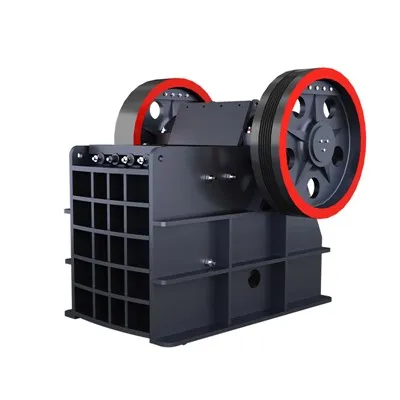
The PE type small jaw crusher is a common small-sized model in the jaw crusher series. Its working principle is compression crushing driven by a crank-rocker mechanism: The motor is driven by a V-belt to rotate the eccentric shaft, causing the movable jaw to periodically approach and leave the fixed jaw. The material is compressed, split, bent and broken in the jaw chamber - transforming from "large pieces" at the feed opening to "small particles" at the discharge opening.
Products features
Simple structure, durable - The main components such as the frame, moving jaw, eccentric shaft, elbow plate, and adjustment seat are straightforward. Even in places with poor maintenance conditions like rural workshops or mountain quarry sites, these machines can operate for a long time.
The feed size is relatively large - The PE250×400 feed can reach 210 mm, and the PE400×600 feed can reach 340 mm. It is one size larger than the feed of the counter-impact crusher or hammer crusher with the same output. Large pieces do not need to be crushed first.
The discharge port is adjustable - The position of the elbow plate can be adjusted by the wedge-shaped adjustment block or the pad group. The discharge opening can be adjusted from 10 to 50 mm. The same machine can produce both coarse and fine materials (fine down to 10–15 mm for the next medium crushing stage).
It can crush hard rocks - Compression crushing is not picky about hardness. Limestone, granite, basalt, and pebbles can all be crushed. Unlike hammer crushers that strike hard rocks with hammers.
Few wear parts and easy replacement - Only the moving jaw teeth plate, fixed jaw teeth plate, and elbow plate are prone to wear. High manganese steel ZGMn13 is used. After wear, they can be flipped over and used again. Replacement only occurs when they are severely worn; the elbow plate is also an "insurance part" - Overload will first break, protecting the main machine.
Products real photo


Work mode
1. No-load startup - Before starting, confirm that there is no residual material in the crushing chamber and the discharge port is not blocked. Start the main unit (electric motor → V-belt → eccentric shaft → moving jaw swing freely), then run smoothly before feeding.
2. Feeding - Uniformly feed into the upper part of the jaw chamber. Do not deviate, do not hit the tooth plate, and do not let iron (iron blocks entering the jaw chamber = broken elbow plate or cracked tooth plate, which is the most common after-sales problem for jaw crushers). For small machines, it is done manually; for large machines, it is done by belt conveyor + iron remover.
3. Compression and crushing - As the eccentric shaft rotates, when the material approaches the fixed jaw, it is crushed (the main crushing area is in the upper part of the jaw chamber). The moving jaw leaves the fixed jaw and the crushed material falls down + the lower part of the material rolls in for further compression.
4. Discharge - Materials smaller than the discharge port size are discharged from the lower chamber and enter the next stage (belt conveyor / silo / secondary crusher).
5. Shutdown (stop feeding first → empty chamber → stop main unit) - Normal shutdown sequence: Feeder stops first → Wait for the crushing chamber to be emptied → Stop the main unit → Cut off the power supply. For long-term shutdown, check the wear of the tooth plate (turn over or replace), check the elbow plate / elbow seat, tighten the V-belt, and clear the chamber.
Application scenario
Laboratory / Laboratory sample crushing
Small quarry crushing
Mobile crushing station primary crushing (construction waste / road stone)
Rural road construction / small water conservancy project crushed stones
Un-electric sites in mountainous areas (with diesel engine models)
Test line of mineral processing plant / primary crushing of small mining sites
Building materials factory (limestone / gypsum) primary crushing
Hot Tags: pe type small jaw crusher, China pe type small jaw crusher manufacturers, suppliers, factory